




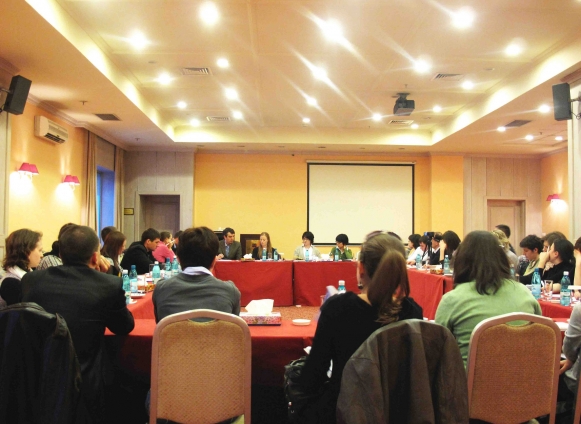
 On March 15 The Promo-LEX Association and The Equal Rights Trust (ERT) held a Public Lecture entitled “Hate crimes based on sexual orientation in Moldova.” The event was organized as part of the project “Strengthening Legal Protection from and Raising Awareness of Discriminatory Ill-Treatment in Republic of Moldova, including Transnistria”, a project funded by the European Union through the European Instrument for Democracy & Human Rights (EIDHR). The project is co-funded by UNDP Moldova within “A joint UNCT for Human Rights Protection and Promotion in the Republic of Moldova” Project.
The event commenced with the launch of the fifth edition of „The Equal Rights Review” (ERR 5). The presentation was made by Libby Clarke, the Legal Officer at ERT. In the context of discussions currently taking place in Moldova on the Draft Law on Preventing and Combating Discrimination, Libby Clarke mentioned two articles that could be of most interest to readers in Moldova: “The new Equality Act 2010 in Britain” and “Islam and Homosexuality.” The first article describes the development of UK legislation on equality and non-discrimination. The second article deals with homosexuality in the context of Islam, thus giving an insight into the correlation between religion and homosexuality, which is currently a controversial issue for Moldova. The publication includes articles focused on other themes in the field of equality and combating discrimination. This publication has been translated into the Romanian language and was distributed to participants of the public lecture. A PDF version is available in Romanian on the website of The Promo-LEX Association here. A PDF version in English is available on the website of The Equal Rights Trust here.
The second part of the event was devoted to discussions on hate crimes relating to sexual orientation in Moldova.
Angela Frolov, Lobby and Advocacy Program Coordinator at GENDERDOC-M presented several examples of hate crimes and verbal abuse based on sexual orientation which have recently been registered in Moldova. Angela Frolov stressed that such cases show the authorities to have an ignorant and aggressive attitude. Most of the time, instead of investigating these cases, law enforcement officials blackmail, assault and persecute gay people. Such an attitude leads most gay people to live a double life, fearing to confess even to those close to them about their sexual orientation. The GENDERDOC-M organization has consistently recorded cases of violence, including sexual, in which the victims are homosexual persons. Angela also presented numerous cases of incitement to hatred and hate speech against homosexual persons. Even though the authorities are aware of these cases, they do not take any measures to punish or prevent them.
The cases of incitement to hatred and hate speech reported by GENDERDOC-M are interpreted by the authorities as being within the limits of the freedom of expression.
Later, Libby Clarke presented an international perspective on the issue. She noted that hate crimes based on sexual orientation are, unfortunately, a universal phenomenon. Libby Clarke defined the terms sexual orientation and homosexuality. In this context, Angela Frolov recalled that in 1990 the World Health Organization excluded homosexuality from the list of diseases, thus, homosexuality is considered one of the three normal human sexual orientations: heterosexual, homosexual and bisexual. Also, Libby Clarke spoke about the two basic elements that define “hate crime”, namely: the presence of a component of a crime and also a bias motive, which in these cases is sexual orientation. In several European countries such as Lithuania and Great Britain, hate crimes are punished more severely than “normal” crimes. In this way, the European countries are contributing to the prevention of such offences in the future.
Libby Clarke also summarised the international legal obligations of Moldova in relation to protecting individuals from discrimination on the ground of sexual orientation, with reference to the International Covenant on Civil and Political Rights and The Yogyarta Principles. She also made reference to decisions of the European Court of Human Rights which confirm that sexual orientation is to be included as a ground of discrimination for the purposes of the prohibition of discrimination set out in Article 14 of the European Convention on Human Rights. Finally, she demonstrated how recent decisions of the European Court of Human Rights, including Nachova v Bulgaria, have confirmed that States such as Moldova have an obligation to protect individuals from hate crimes.
“In Moldova, there is still no legislation in the field of non-discrimination. The Draft Law on Preventing and Combating Discrimination, once adopted, would complement the Criminal Code of Moldova and would introduce the concept of “hate crime”, which currently is not defined in the legislation of RM. Thus, any offense under the Criminal Code committed on the basis of discriminatory criteria should be treated as an aggravated offense, “said Doina Ioana Straisteanu, lawyer in the project.
At the same time, even in the absence of anti-discrimination laws, a lawyer skilled and interested in defending his client’s rights can use the existing legislation to his advantage.
In this regard, Article 77 Aggravating Circumstances under the Criminal Code, paragraph 1, letter (d) qualifies what is considered to be an aggravating circumstance: “the commission of a crime due to social, national, racial, or religious hatred;.” In this respect, hate crimes based on sexual orientation could be assigned to social hatred and judged accordingly.
Article 78 Effects of Mitigating and Aggravating Circumstances under the Criminal Code in paragraph 3 stipulates “In the case of aggravating circumstances, the maximum punishment set in the corresponding article of the Special Part of this Code may be applied”.
Article 145 Deliberate Murder, Article 151 Intentional Severe Bodily Injury or Damage to Health and Article 197 Deliberate Destruction or Damaging of Goods under the Criminal Code state that when the offenses are committed out of social, national, racial, or religious hatred, they shall be punished in accordance with the relevant provisions of the Criminal Code, including imprisonment.
In this respect it is relevant to define the term social as: 1) what is relevant and common to society; 2) what belongs to a certain class or a particular group in society; and 3) what is specific to a group of people.
Also, help for human rights defenders and lawyers can be found in Article 176. Violation of Citizens’ Equality of Rights under the Criminal Code which states: “The violation of citizens’ rights and freedoms guaranteed by the Constitution and other laws on the grounds of sex, race, color, language, religion, political, or any other opinions; national or social origin; association with a national minority; property; birth or any other situation: service for 150 to 240 hours or by imprisonment for up to 3 years, in all cases with (or without) the deprivation of the right to hold certain positions or to practice certain activities for 2 to 5 years.”
“Bringing such cases and their respective arguments to the courts would allow the development of jurisprudence that would condemn and punish hate crimes, including those based on sexual orientation in Moldova,” said Doina Ioana Straisteanu.
In this respect, the role of law enforcement authorities is also very important because they are responsible for collecting evidence and conducting prompt further examination of the causes and transmission of these data files for the court.
The ‘Red line’ of the event was that discrimination and hate crimes based on discrimination, including based on sexual orientation, are related to human rights issues and should be treated as such. International human rights practice is very explicit when it comes to fundamental human rights violations. Thus, freedom of expression and freedom of religion may be restricted under certain circumstances, while the right not to be subjected to ill treatment, including discriminatory mistreatment, falls under Art 3 of the European Convention on Human Rights, and is an absolute right.
Participants at the event, civil society representatives, lawyers, law students and students from the journalism faculty, stressed the usefulness of such events that help promote democratic norms and values and that enhance the legal culture of society.
Contact Person : Olga Manole, Project Coordonator, Promo-LEX Association
Tel (+373 22) 449626, [email protected]