




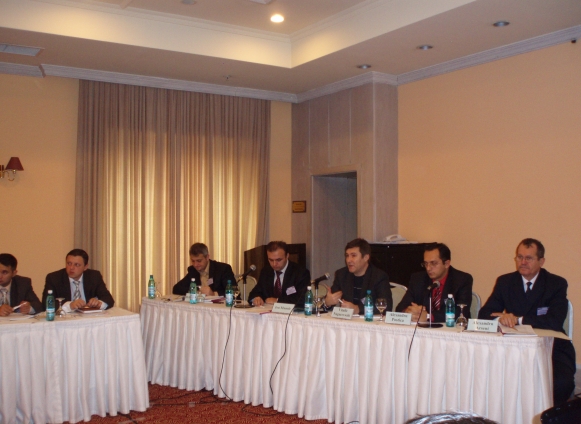
 11 November 2009 / The Promo-LEX Association presented a study focussed on an analysis of the situation with respect to freedom of assembly, liberty and security of person and the right not to be tortured, freedom of mass-media/freedom of expression, and the functioning of state democratic institutions, during the post-election period in Moldova (6 April- 1 July).
The authors of the study presented their findings based on objective assessments of the causes and consequences of the dramatic events seen in Moldova in the aforementioned period, outlining at the same time concrete recommendations for the authorities and other concerned bodies.
Present at the opening of the event, President of the Parliamentary Committee set up to investigate the April events, Vitalie Nagacevschi, stated that, following the parliamentary elections on April 5 2009, human rights were flagrantly violated, and that democratic institutions were inappropriately influenced by politics. The most prevalent violations involved the use of torture on the part of the police. The existing mechanisms, he said, were not efficient enough to guarantee respect for human rights.
Alexandru Postica talked about the rights and obligations of the local public authorities with respect to cooperating with the police and organisers of assemblies, outlining the rights and obligations of all parties. If public order is violated during an assembly, then, according to the law, police and representatives of the local public administration should disperse the meeting in conformity with legal provisions, first giving warning of the measures that will be taken. He warned that, in cases where the law is not respected, organisers and participants will be held accountable, in conformity with legal provisions. Police employees who act illegally must also be held accountable. The author elaborated a set of recommendations for all the relevant parties: Local public administration bodies, firstly, should: co-operate closely with the police, facilitate the notification procedure and organisation of meetings, and ensure realisation of the right to assembly. Organs of the Interior Ministry should: take measures to build public confidence in the capabilities of the police, develop skills and tactics to combat inappropriate and aggressive behaviour, and encourage better co-operation between the police and the local public administration. The prosecution bodies should: start an investigation (carried out by the Prosecutor General) into both cases of violations of the right to free assembly and cases of police inaction, and sanction the senior officers of the law enforcement bodies who did not fulfil their duties. The parliament should: change the law so as to clearly establish the duties and rights of both the local administrative bodies and the police, and supplement chapter V of the Law on Assemblies with a new article clearly indicating the responsibility for violating the Law, and including stipulations on the possibility of collecting for moral and material damages caused by the local authorities and police actions.
Legal expert Ion Manole highlighted violations of Rule-of-Law principles during the April events, as well as abuses committed by precisely those organs charged with ensuring respect for the rule of law: arbitrary detention, maltreatment and torture during detention, violations of procedural norms, delays made to the efficient and swift investigation of cases of abuse and death, and the troubling findings of medical/legal experts. The author emphasised in particular the tolerant and supportive attitude shown by authorities towards certain troubling developments – which led to violations of the rule of law- and the lack of official reaction. He presented to the parliamentary commission recommendations that should be implemented to better elucidate the aforementioned events (transparency, the involvement of foreign specialists and civil society groups, the objective establishment of the truth) and proposed a change to the legislation with a view to preventing the re-emergence of factors that could lead, once again, to the violations seen in April. Manole stressed the readiness of civil society groups to get involved in the proposed measures.
Expert Petru Macovei displayed the results of the monitoring and evaluation of how mass-media portrayed the post-election events in Moldova, affirming that most TV stations violated ethical principles when presenting the developments. The stations Moldova1, NIT, N4 and Prime TV presented the news selectively, informed citizens in a non-objective fashion, and manipulated text and images, all in a manner that favoured the Communist Party. The national television channel Moldova 1 presented information that was biased in favour of the then ruling party. The expert made recommendations for the press: to present events in an objective and impartial manner, to extend the right of reply to all the parties involved, to present a review of the conflict using alternative sources, and to take into account the political beliefs of different sections of the population. He also advised that the Coordinating Council for audiovisual media conduct a self-review, and take measures to ensure the delivery of complete, objective and truthful information, the right to free expression, and the free communication of information via mass media.
Prof. Alexandru Arseni explained how, in the period under study, the functioning of the democratic institutions in Moldova left a lot to be desired. He noted how the parliament in office on April 6 was to form a parliamentary committee, but did not do so. The new parliament elected on April 5 created a committee under Vladimir Turcan, but the latter did not submit any progress report. After much delay, a parliamentary committee was created which has recently started to function. Arseni added that delays in investigations make it more likely that potential evidence for criminal cases will be lost or destroyed. Arseni had strong words of criticism for the Supreme Magistrates’ Council concerning the performance of the judges who examined the cases of the protestors, and the fact that it did not task itself with examining cases in which arrest warrants were issued in the offices of prosecuting officers. The expert welcomed various positive changes seen in the work of the advisory council to the Constitutional Court, stating that information is first debated in this council, and then examined by the Court.
Natalia Belitser from the ‘Institute for Democracy Pylyp Orlyk’ in Kiev took part in the round-table as a special invitee. Mrs Belitser presented a view of the April events from the perspective of a neighbouring country, Ukraine. Participants at the discussion were given the chance to learn that, during the dramatic April events, several Ukrainian journalists and citizens were denied access to Moldovan territory. Both at constitutional-authority checkpoints, and at those under illegal Transnistrian control, customs officials behaved in a similar fashion, and used the same arguments to refuse entry into Moldova. In Mrs Belitser’s view, this shows that the actions were co-ordinated from a single point. The Ukrainian expert believes that the dramatic events in Moldova have changed the view of many regarding the situation there.
Present at the event were representatives of civil society, deputies and representatives of various state bodies, representatives of diplomatic missions, lawyers, and those who were direct victims of abuse at the hands of the authorities in April.
The study in Romanian and English is available here.
The study was made with financial support from the Black Sea Trust for Regional Cooperation /A Project of the German Marshall Fund.