




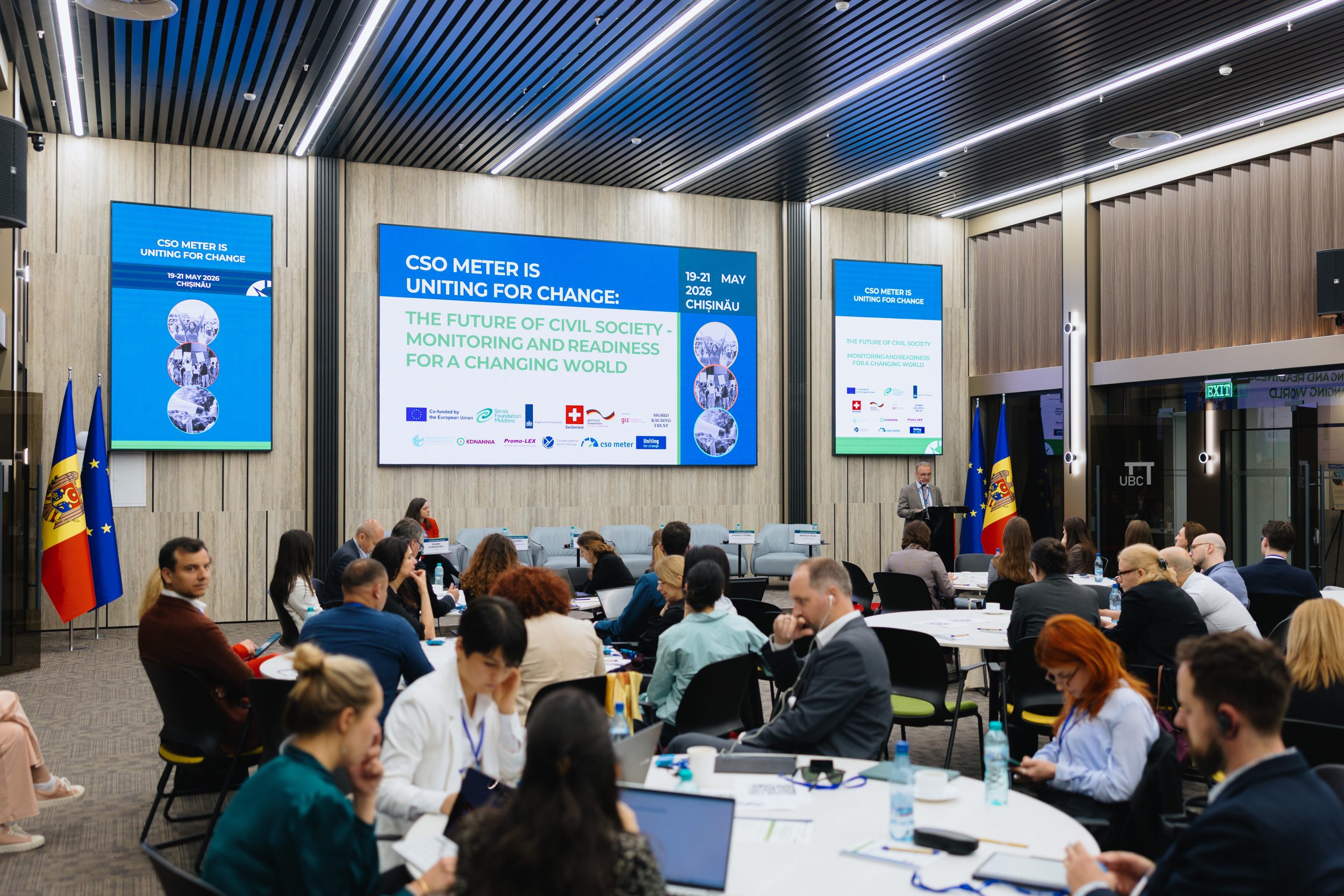
From 19 to 21 May 2026, over 100 representatives of civil society organisations, international institutions, donor organisations, experts, and practitioners from the Eastern Partnership region, the Western Balkans, Central Europe, and beyond gathered in Chișinău for the high-level convening “CSO Meter is Uniting for Change: Shaping the Future of Civil Society – Monitoring in a Changing World.”
The event was organised by the European Center for Not-for-Profit Law Stichting (ECNL) and the Promo-LEX Association within the framework of the EU-funded “CSO Meter: Empowered for Action” project and as part of ECNL’s “Uniting for Change” initiative.
The three-day convening included two major components: a high-level public conference that brought together a broad range of regional and international stakeholders, and a closed strategic workshop dedicated to civil society monitors and partners working in challenging and restrictive environments.
The public conference provided an important platform for dialogue, solidarity, and strategic reflection at a time when civic space and democratic freedoms are facing growing pressures across the region. Participants discussed the accelerating challenges affecting civil society, including democratic backsliding, authoritarian trends, disinformation, foreign interference, shrinking civic space, funding insecurity, and increasing pressure on independent media and civic actors.
The discussions highlighted that the Eastern Partnership region continues to experience deep and uneven democratic challenges. While countries such as Moldova and Ukraine continue pursuing reform-oriented and European integration paths under difficult conditions, civil society actors in Belarus, Azerbaijan and Georgia continue to operate under severe restrictions, including from exile or in highly constrained environments.
Participants underlined that civil society organisations remain indispensable actors in protecting democratic values, supporting vulnerable communities, monitoring human rights, countering disinformation, and strengthening public participation and accountability. At the same time, they stressed that civic space cannot be taken for granted and requires continuous protection, investment, and cross-border solidarity.
Throughout the public conference, participants explored innovative and forward-looking approaches to strengthening civil society resilience and preparedness. Discussions focused on improving monitoring methodologies, using digital tools and emerging technologies, building cross-sector alliances, ensuring sustainable support for civil society organisations, and identifying practical ways to respond to evolving restrictions and hybrid threats.
The conference featured several thematic panels addressing key regional and global trends shaping the future of civic space. Participants exchanged experiences and lessons learned from countries across the region, including Ukraine, Moldova, Armenia, Belarus, Azerbaijan, Hungary, and Romania. Particular attention was given to the role of monitoring initiatives such as the CSO Meter in transforming evidence into action and supporting timely advocacy and policy responses.
Discussions also focused on the role of financial institutions, businesses, and international partners in strengthening democratic resilience and supporting civic participation. Participants emphasised the need for stronger cooperation between civil society, donors, public institutions, and private actors to ensure that support for civic space remains sustainable and adaptable in an increasingly uncertain global environment.
The strategic workshop created a safe space for in-depth exchange and collaborative planning among civil society monitors and partners. During the two-day workshop, participants discussed ways to strengthen coordination in the context of an increasingly restrictive regional environment for civil society organisations. They also explored possible future scenarios regarding developments affecting civic space and discussed how to prepare more effective responses to emerging challenges, including through early warning systems and foresight methodologies.
Workshop participants further examined new ways to integrate digital technologies and artificial intelligence into civic space monitoring and communication of findings. Particular attention was also dedicated to safety, resilience, and operational sustainability in hostile environments, including through mutual learning, exchange of practices, and regional solidarity among organisations working under pressure.
The convening also highlighted the growing importance of innovation in civic space monitoring, including the use of digital technologies, artificial intelligence, data collection, storytelling, and new cooperation models to strengthen participation, safety, and impact.
Special attention was given to developments in the Republic of Moldova. Participants noted that Moldova continues to maintain a comparatively open environment for civil society and remains committed to its European integration agenda. At the same time, concerns were raised regarding hostile narratives targeting organisations receiving foreign support, challenges related to freedom of assembly, disinformation, and the need to ensure that responses to hybrid threats fully respect human rights and democratic standards.
Participants welcomed ongoing reform initiatives in Moldova, including efforts to modernise public participation mechanisms and introduce anti-SLAPP protections for journalists, activists, and civil society organisations. At the same time, they emphasised the importance of maintaining meaningful dialogue with civil society and ensuring that future legislative initiatives fully comply with international human rights standards.
The convening concluded with a strong call for continued regional cooperation, sustained investment in civil society, and stronger collective preparedness to address emerging challenges affecting civic space and democracy.
Participants reaffirmed that independent civil society remains essential for resilient democracies, protection of human rights, and sustainable peace and stability across the region.
The event was organised within the framework of the Action “CSO Meter: Empowered for Action”, funded by the European Union, and forms part of ECNL’s “Uniting for Change” initiative. CSO Meter is implemented by ECNL together with its partners: Transparency International Anticorruption Center in Armenia, Promo-LEX Association in Moldova, and ISAR Ednannia in Ukraine. The event was co-financed by the Embassy of the Kingdom of the Netherlands in the Republic of Moldova, the Soros Foundation Moldova, the Swiss Cooperation Office in the Republic of Moldova, and The Federal Ministry for Economic Cooperation and Development (BMZ) through GIZ.