




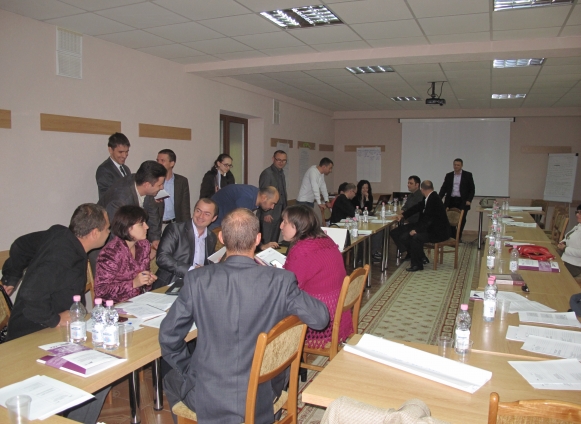
 During 21-23 September 2012, Promo-LEX Association held a training event themed “Defending human rights in the Transnistrian region by using national and international instruments and mechanisms”.
The training was organized as part of the project “Strengthening Civil Society Capacity to Promote and Defend Human Rights in the Transnistrian Region of Moldova”, implemented with financial support offered by Civil Rights Defenders.
The main goal of the training was to improve expertise and skills of NGO representatives, lawyers and human rights activists in employing national and international mechanisms for defending human rights in the Transnistrian region of Moldova.
The training’s theoretical sessions discussed the following issues: basic human rights concepts; the importance of human rights observance in conflict areas; findings by the UN, CPT and other special rapporteurs on the human rights situation in Transnistria; the application of alternative, non-legal mechanisms for defending human rights and the protection of human rights defenders; defending human rights in Transnistria based on the de facto legislation applied in the region; the obligations of the Moldovan authorities with respect to the human rights violations in the region and the limits of capacities of the law enforcement agencies; the role of the Joint Control Commission, the role of mediators and other foreign stakeholders; the responsibilities of Russia following ECHR judgments on human rights violations in the Transnistrian region; and others.
During practical sessions, participants used actual cases as examples to try on the roles of different actors in the process of defending certain rights, acting as representatives of either the victim or the government and proposing steps for settling the problem. The participants also simulated the procedure of complaining to the ECHR of human rights violations, using as examples actual cases from Promo-LEX Association’s case-load.
The training participants, mostly lawyers, agreed that people living in the eastern districts should enjoy their rights equally with all the residents of the Republic of Moldova. “It is unjust that they cannot make use of the national or international human rights defense mechanisms to which Moldova is a party”, said one participant. The participants also appreciated the way the trainers, Promo-LEX experts, presented and provided arguments for the practical aspects of defending human rights in the region.
“It is extremely important that every resident of the Transnistrian region is aware that he or she is under the protection of the European Convention [on Human Rights], ever since Moldova ratified the Convention on 12 September 1997, and it’s our duty to explain this to as great as possible number of persons”, said Ion Manole, executive director of Promo-LEX Association.
Pavel Postica, Promo-LEX lawyer, said: “The eastern region of Moldova is home to roughly 500,000 people who are under the de facto jurisdiction of two governments, of Moldova and that of Russia. It is unfortunate that the people living in the region and the human rights defenders don’t make full use of this advantage by taking their complaints to the ECHR, the only court of law that can impartially administer justice. At the same time, we would like to praise those who already had the courage and initiative to complain to the European Court of human rights violations committed by representatives of the region’s administration or by agents of the governments of Moldova or Russia”.
Promo-LEX Association has a vast experience in defending human rights before the European Court. Since 2004, Promo-LEX has lodged over 40 applications with the ECHR concerning human rights violations committed in the Transnistrian region. In 2010-2011, the Court notified in an urgent manner the respondent governments, Moldova and Russia, on 10 of those applications, and hearing for some of them was fast-tracked. Further, on three applications where Promo-LEX represents 170 plaintiffs, (Catan and others vs Moldova and Russia, Căldare and others vs Moldova and Russia, and Cercavschi vs Moldova and Russia) the Court on 15 June 2010 pronounced admissibility decisions and, following public hearings on 25 January 2012, a judgment on the merits is now expected to be pronounced by the European Court’s Grand Chamber.