




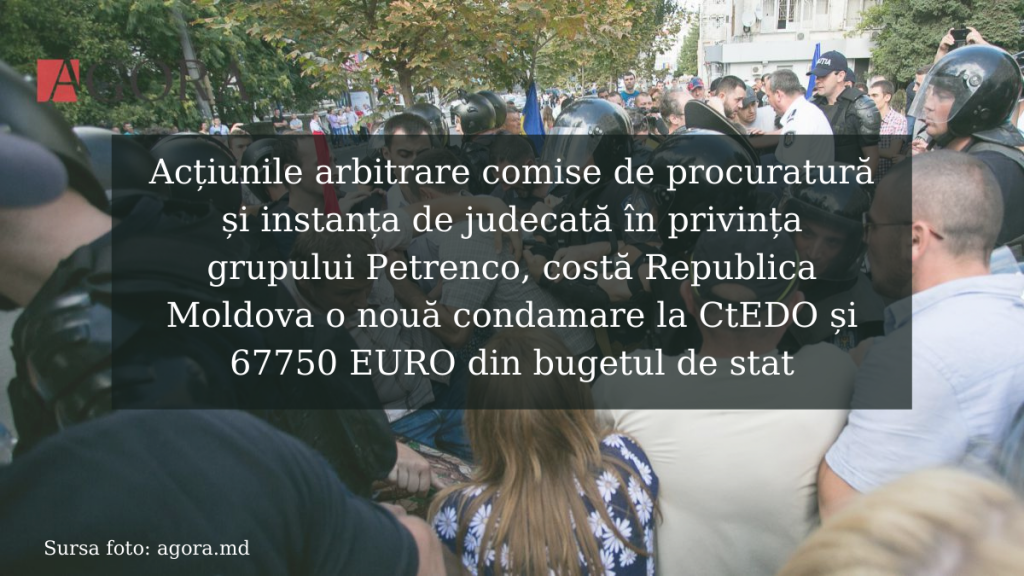
On September 14, 2021, the European Court of Human Rights (ECHR) issued a judgment in the case of Petrenco and 6 others against the Republic of Moldova, recognizing the violation of several articles of the Convention by the Republic of Moldova.
The plaintiffs’ complaint to the ECHR
The case concerns the retention, arrest and detention of the plaintiffs on the basis of allegations of mass disturbances, following a demonstration which they organized in front of the General Prosecutor’s Office in September 2015. All the plaintiffs were detained for four and a half months in penitentiary no. 13 and, for approximately the same period of time, were under house arrest. While they were under house arrest, the plaintiffs were forced to wear electronic bracelets, which they had to charge every five hours.
The plaintiffs complained to the ECHR about the following violations of the Convention:
The first plaintiff complained about the conditions of detention in penitentiary no. 13. The plaintiff’s detention in Penitentiary no. 13 was an inhuman and degrading treatment, violating Articles and 8 of the Convention.
All plaintiffs complain, under Article 5 § 1 of the Convention, that deprivation of liberty was not based on a reasonable suspicion that they had committed a crime and that their detention was arbitrary and illegal. They also complain, pursuant to Article 5 §§ 3 and 4, that their deprivation of liberty was not based on relevant and sufficient grounds and that the national courts did not give sufficient reasons for their judgments on the application and extension of preventive measures.
All, with the exception of the first plaintiff, complained under Article 11 of the Convention that the plaintiffs’ right to peaceful assembly had been violated by the application, as a precautionary measure, of prohibitions on going to places where mass protests were taking place.
With the exception of the first and fourth plaintiff, the plaintiffs complain, under the provsions of Article 13, that they have not had an effective remedy against the violation of Article 11 of the Convention (concerning the prohibition laid down by the court to participate in public meetings).
ECHR decision
Art. 5.1., Art. 5.3, art. 5.4 – allegations of involvement in mass disorder were not based on reasonable suspicion
The Court found that the plaintiffs had been arrested and charged with the offense of participating in mass disturbances, which, according to Article 285 of the Criminal Code, is described as involving “violence against persons, pogroms, arson, damage to property, the use of firearms or other objects used as weapons and violent or armed resistance to the representatives of the authorities ” (see paragraph 22 of the Decision).
After examining the videos of the demonstration of September 6, 2015, included in the case file (see their detailed description in paragraphs 7 to 10 of the Decision), the Court finds that the allegations of the plaintiffs’ violent behavior are totally incompatible with the footage contained in those videos. According to the videos in question, the authenticity of which was not disputed by the Government, the meeting in general and of the plaintiffs in particular were peaceful throughout. It is true that the police used force to push the protesters away from the entrance to the building, but the latter showed no violent or armed resistance and were removed from the entrance to the building in 2-3 minutes (see paragraphs 7-8 of the Decision).
The Court found that Svetlana Balmus, the Judge of the Court of Appeal had stated in her separate opinion that the meeting was peaceful (see paragraph 16 of the Decision). The Court also took note of the finding of the Supreme Court of Justice in its decision of 11 February 2020 that, in sentencing the plaintiffs, the lower courts relied solely on the presentation of the facts presented by the prosecution and did not pay attention to the evidence in criminal proceedings and defense evidence (see paragraph 18 of the Decision).
In such circumstances, it is impossible for the Court not to find that the allegation of participation in mass disturbances against the plaintiffs was not based on a “reasonable suspicion” and cannot therefore be considered “legal” and is arbitrary within the meaning of Article 5 § 1 of the Convention (see the case of Brega v. Moldova, no. 52100/08, § 38, 20 April 2010). There has therefore been a violation of Article 5 § 1 of the Convention.
Art. 11 – Violation of the freedom of assembly. Illegal prohibition applied to plaintiffs on participating in public meetings
As regards the lawfulness of the above interference, nothing in this case did not allow the Court to consider that there was a legal basis for restricting the plaintiffs’ right to freedom of assembly. The Court finds that, indeed, the Article 191 of the Code of Criminal Procedure (see paragraph 23 of the Decision) does not provide for such a procedural measure and the Government has not indicated any other domestic legal provisions allowing such a measure to be imposed on a released person and which is awaiting trial. Thus, the Court concluded that the interference in question was not lawful under national law.
Damages to be collected
The Court ordered the Government of the Republic of Moldova to pay the plaintiffs the total amount of EUR 63750, as non-pecuniary damage, for the violations committed and the amount of EUR 4000, as costs and expenses of representation and legal assistance before the ECHR.
Comments of the lawyers of the Promo-LEX Association
According to Program Director and lawyer Vadim Vieru, “This case highlights systemic issues related to the legality and validity of the application and extension of preventive detention measures, as well as the limitation of the right to freedom of assembly by applying, as a provisional measure, the prohibition to go to places where mass protests are taking place. The Court finds that there is no reasonable suspicion as to the commission of the offense and the arbitrary assessment of the evidence by the court, by exclusively reproducing the position of the prosecution”.
According to the lawyer of the Promo-LEX Association, Nicoleta Hriplivii, “In a state where the Government limits the pluralism of opinions, freedom of expression or assembly, democracy is in danger. At that time, society witnessed the degradation of democracy in the Republic of Moldova, where freedom of expression, the right to safety and freedom of persons, were most often violated rights. All judgments of the European Court of Human Rights indicate where the State has gone wrong and these human rights violations should not be repeated in the future.”