




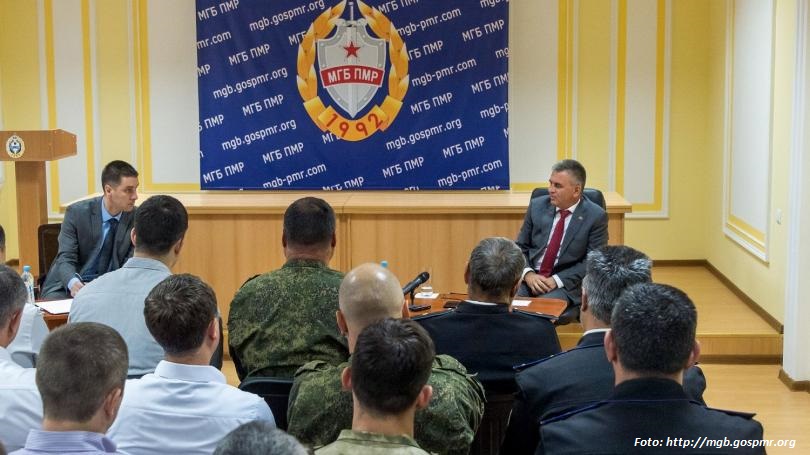
The non-governmental organizations became a threat for the group of people controlling economically, administratively and politicly 11% of the Moldovan territory. In 2015 the secessionist Tiraspol regime banned Promo-LEX Association access in the Transnistrian region. It has been five years since the local KGB filled in criminal charges for Promo-LEX representatives, and we wanted to find out more about the environment in which the non-governmental organizations in the Transnistrian region of the Republic of Moldova carry out their activities.
The “Apriori” information and legal assistance center in Tiraspol has become a last fortress of the civil society on the left bank of the Dniester. Apriori is the only organization in the region to which the provisions of the Law on “non-commercial” organizations of Russian inspiration have been applied.
The “Apriori” activity, like that of Promo-LEX, is under the local KGB’s thick magnifying glass. The two organizations have become the targets of the secret service, as they are encouraging, informing and defending the inhabitants of the region whenever their rights are violated.
The case of Apriori
Larisa Kalik, a 22years-old journalist from Tiraspol, was forced to leave Moldova after launching in December 2019 the volume “Year of Youth” about the experience of young people in the alleged “Transnistrian army”.
“Initially, in December [KGB employees] called my mother. They visited my former school requesting a testimonial of mine from the principal” the young woman retells me casually the communication with the local KGB employee. One month later, in January, she was wanted on the phone by a man who appeared as an officer of the same dreaded security service.
 Larisa Kalik, author of the volume “Year of Youth”. Photo: Facebook.com
“I asked him his name and the military rank. He said he can only give me such details during a meeting. Within a week, he called me again and I told him I was not in Tiraspol. “ The young woman has hired a lawyer who informed her about “what could happen to her.” She was not eager to talk about such details, hoping she would not get to them. In Transnistria, the KGB can start criminal prosecution in the case of criminal charges for separatism, extremism, etc. Therefore, the persons pursued by this service have the right to defense, which can only be provided by a lawyer.
Larisa’s case is likely to be a lesson for her colleagues and for human rights activists in Transnistria. Her colleagues only told me that she was “taken out of Transnistria”, either to protect her or to show that they had nothing in common with her.
By publishing the testimonies of the 12 young people, the journalist wanted people to speak and reflect about the “Transnistrian army”. The discussions were organized within the “Club 19”, a forum of the non-governmental organization “Apriori” in the capital of the region. “A lot of people gathered in Tiraspol. We had held discussions in Dubăsari and Râbnița within the same “Club 19”. Most of the participants agreed on the reported issues, but of course there were disputes as well. “
The Promo-LEX Association from Chisinau compares the military service in the Transnistrian region with “illegal deprivation of liberty, manifested by detention in the paramilitary units in the eastern part of the Republic of Moldova”. The evasion from this “military service” is sanctioned with a fine of about $ 600 or up to two years in prison. The “Club 19” forum first appeared within Apriori, Tiraspol, with the support of the Czech organization “People in need”. Later on, it was expanded geographically to Dubăsari and Râbnița.
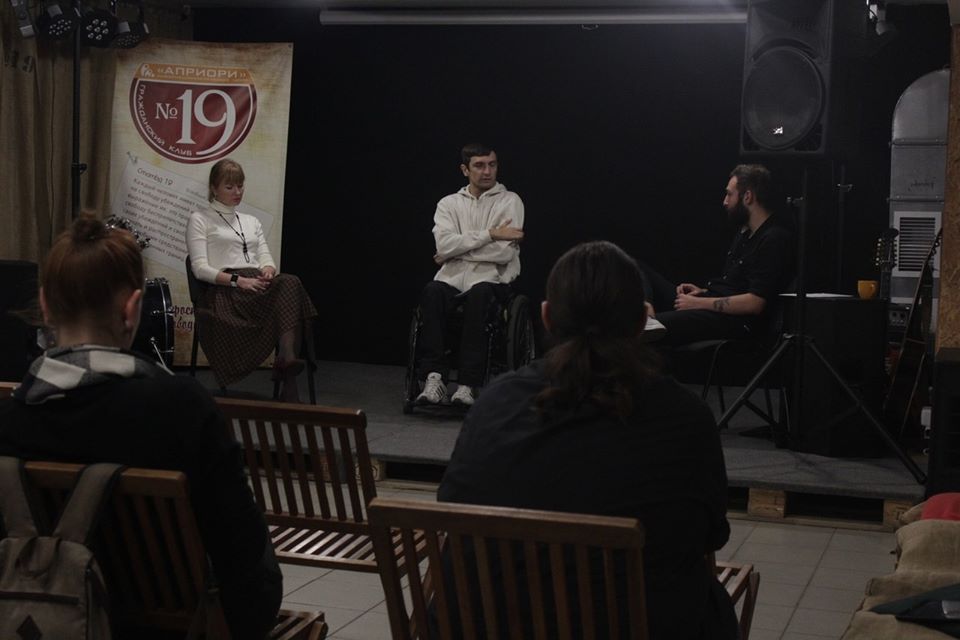 “Club 19”, a forum of the “Apriori” Center in Tiraspol. Photo: Facebook.com
“There is no subordination and mutual obligation between these structures. The representatives of the platforms collaborate in organizing public discussions “, said the director of the organization, Evgheni Dunaev. The forum was named after Article 19 of the Universal Declaration of Human Rights: “Everyone has the right to freedom of opinion and expression. This right includes the freedom to hold opinions without interference from outside, as well as the freedom to seek, receive and disseminate information and ideas through any means and regardless of state borders. “
The interest of the KGB people for the members of the organization once the public activists and journalists diversified their activity, as they “touched” “forbidden” issues and topics. “Six years ago, the KGB recruited a first-year student from the University of Tiraspol to infiltrate into our organization. The young man was actively involved in our discussions, and we hired him as a journalist “,Evgeni Dunaev reports.
“The boy hesitated and, one day the invited him to a university office and scared him. They had told him that if he did not want to collaborate with them, he would not pass the exams and thus he would get into the army, and there the things would not be good. His mission was to spy on our colleagues and report. He had to find out the password of our email. They started to pressure him, scare him with tormenting sounds and, finally, the boy gave up … He told us about his mission. “
Apriori is the only non-governmental organization in Transnistria to which the Law on Non-Commercial Organizations was applied – a law of Russian inspiration, adopted in 2018, providing for the closure of the organizations supported from outside, which hold public discussions. On the left bank of the Dniester the recently adopted Moldovan Law on 2% is not applied, and there are no internal donors for non-governmental organizations. In November 2018, the Transnistrian prosecutor’s office conducted the first verifications at the “Apriori” Center and established that it “is doing politics” through its activities.
“According to the same law, after a half a year, the prosecutors were to carry out other checks and file other charges, which did not happen. In order to close the organization, there is still a need for control,“ Apriori lawyer Stepan Popovski noted.
However, Evgheni Dunaev emphasized that Apriori continues to advocate for human rights and to provide voluntary legal assistance to people having problems with the regime. “The risk of eventual early closure of the organization increases once with its possibility to receive grants from outside. “ The secessionist authorities had also banned any relations of Apriori with other human rights non-governmental organizations.
The case of the Promo-LEX Association
The Promo-Lex Association from Chisinau has been officially banned in Transnistria as of 2015. The so-called State Security Committee has opened a “criminal investigation against Promo-LEX for the alleged” actions aimed at interrupting the 5 + 2 negotiation process “and for” subversive actions against the Transnistrian statehood “
“The charges are not clear and have not been notified to us. We tried to apply local rules and procedures but we failed to defend our rights and interests. The Tiraspol regime sought to keep us away from this region “,the program director of the Association, Alexandru Postica claims.
Tiraspol separatist regime has started to follow Promo-LEX activity and create obstacles for us since 2007. The members of the association realized that it is more efficient to contribute to building and strengthening of the nongovernmental sector in Transnistria. “Where there is no independent press, no open access for diplomats, journalists, lawyers in this area, only authentic local organizations would be able to deal with such a large number of human rights violations,” notes Postica.
Based on these beliefs, in 2006-2008 Promo-LEX organized the Forum of Transnistrian NGOs. “In addition, for five years [2006-2011] we organized numerous information and training activities, including funding for local organizations.
We have been providing legal assistance to the local people in the local courts, in the national and international ones “, evokes Ion Manole, the executive director of Promo-LEX.
In parallel, the local KGB launched a derogatory campaign against the association, resorting to threats against the organization’s partners and beneficiaries. “In 2007 the security service in the region summoned all the forum participants in a room. The military people told them that if they continue to participate in our activities, they may have problems. “
Consequently, Manole added, the non-governmental organizations that remained in Transnistria were forced to give up the human rights activities and the promotion of the democratic values. They were forced to choose activities “peculiar to the NGOs” such as humanitarian, social, ecological and to cooperate with the regime. “Each organization in the region has been appointed a local KGB agent as a curator, regularly visiting the organization and discussing with the people involved.”
Manole revealed that the donors accepted this condition. The most them refused to support human rights activities, accepting the game of the Tiraspol administration. “As a consequence, the inhabitants were left without a defense shield in an isolated region, where the human rights are neither known nor promoted and, moreover, they cannot be defended.”
A discussion platform for identifying solutions
The lawyer of the Apriori Association, Stepan Popovschi, says that Chisinau authorities’ actions are not far enough to provide an effective mechanism for the defense of human rights in Transnistria.
“The amendments to the Law of Justice on the right of the applicants from Transnistria to apply to the courts of the Republic of Moldova is a half measure. To what laws should the complainant from the left bank of the Dniester refer when addressing a court in the Republic of Moldova? “, the lawyer wonders.
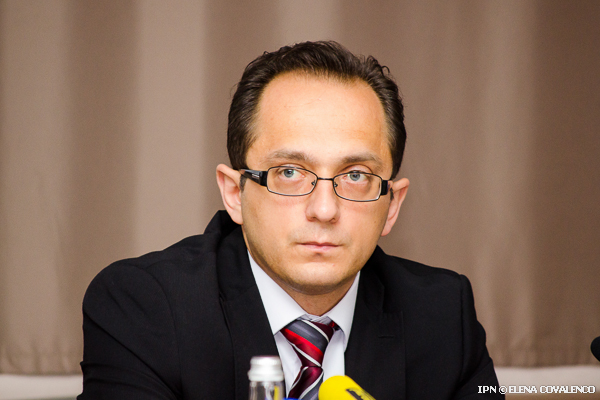
Alexandru Postică, director of human rights programs at the Promo-LEX Association
“He is obliged to refer to Moldovan laws, but the Government from Chisinau does not ensure their functioning on the Transnistrian territory.” Therefore, the authorities from Chisinau ignore the fact that the citizens on both sides of the Dniester are in fact in different situations. The same approach to the legal defense is discriminatory for the people from the eastern districts of the Republic of Moldova.
The attitude of the Moldovan Government towards ensuring human rights in Transnistria is contrary to the ECHR’s position, namely “the obligation to disregard the deeds of the entities in fact is far from absolute”.
Where about half a million people do not have legal means of defense, the lawyer Popovski insists on the idea of establishing a court with special prerogatives, in Chisinau, which would work according to the principle of the European Court of Human Rights.
Ion Manole, in this turn, advocates for a platform “in which the authorities, experts and those concerned would seek solutions”: “The Promo-LEX tendency to refer the files to the ECHR, he added, is explained by the hope that the increasing number of cases examined and decisions will make the constitutional authorities, civil society and international partners understand the complexity of the problems faced by the inhabitants of this region. “
“My highest expectations in this case, underlined Manole, were related to the efficient involvement of the OSCE Mission in Moldova. The OSCE could have played an active and decisive role in this process. Unfortunately, neither the constitutional authorities nor the relevant actors are disturbed by the issues reported by the inhabitants of the region. Impunity in Transnistria remains comfortable at home and feels great.”
The article is developed within the project “Promoting Human Rights in Transnistria”, implemented by the Promo-LEX Association with the financial support provided by the National Endowment for Democracy.