




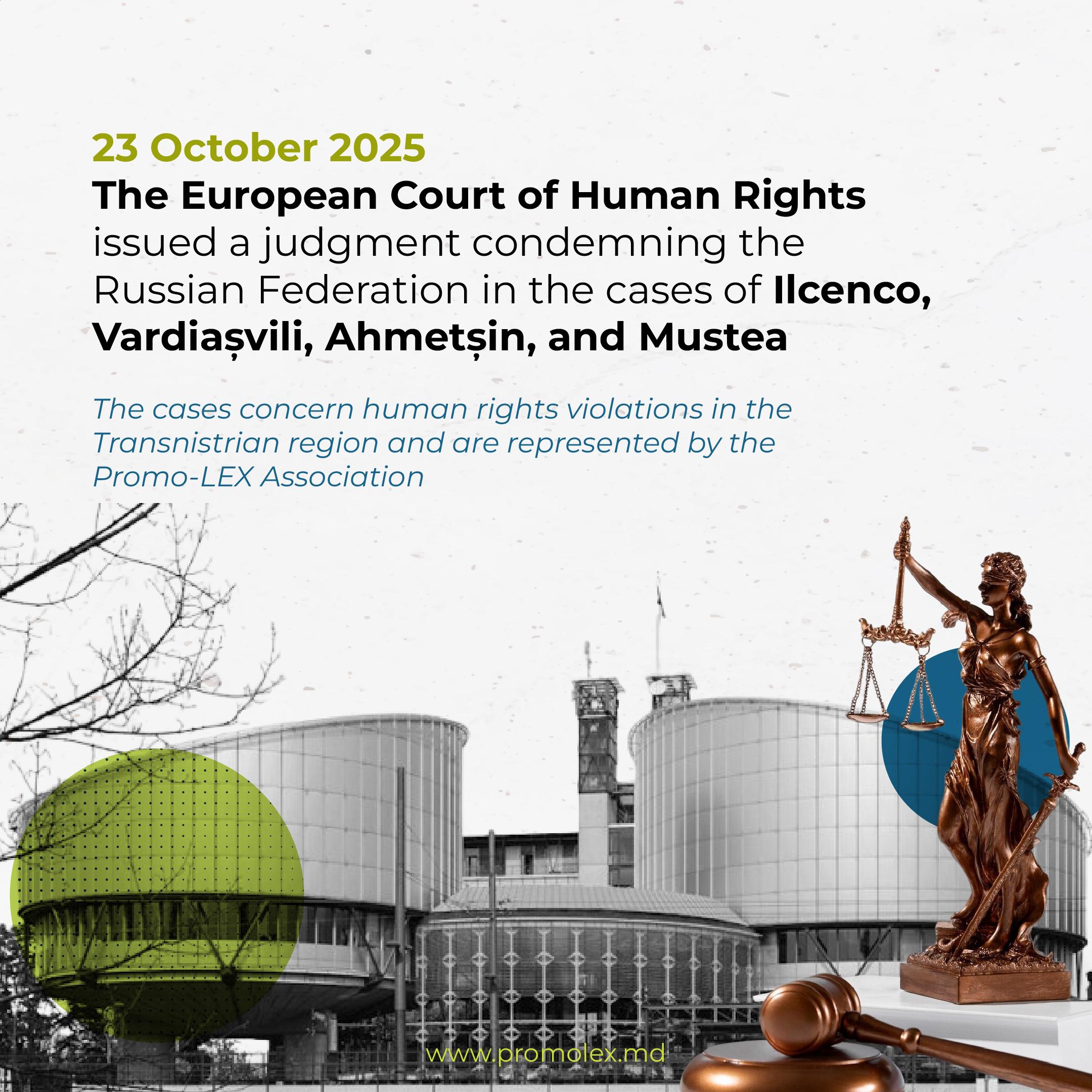
Chișinău, 24 October 2025
On 23 October 2025, the European Court of Human Rights (ECHR) delivered a judgment in four cases concerning five residents of the Transnistrian region – applicants represented by lawyers from the Promo-LEX Association. In all four cases, the Court found serious violations of the European Convention on Human Rights (the Convention) by the Russian Federation, including unlawful detention, ill-treatment, violations of the right to a fair trial, freedom of movement, and freedom of expression. The Republic of Moldova was not found responsible for these violations; however, the cases highlight the vulnerability of people living on the left bank of the Nistru River and the urgent need for action to protect human rights in the region. The ECHR ordered the Russian Federation to pay the applicants over €100,000 in total as compensation for moral damages and legal costs.
The ECHR judgment of 23 October 2025 confirms the violation of the rights of five individuals from the left bank of the Nistru River, victims of abusive detention and convictions imposed by the de facto Transnistrian administration. The cases concerned are Ilcenco, Vardiașvili, Ahmetșin, and Mustea.
The Russian Federation was found responsible for the violation of several articles of the Convention (Article 3 – prohibition of torture and inhuman or degrading treatment, Article 5 – right to liberty and security, Article 8 – right to respect for private life, Article 10 – freedom of expression, Article 13 – right to an effective remedy, etc.), and was ordered to provide financial compensation to the applicants. The ECHR reaffirmed Russia’s jurisdiction and responsibility over events in the region (for acts committed prior to 16 September 2022). The Republic of Moldova was not found liable for these violations.
Compensation and costs exceeding €100,000 are to be paid by the Russian Federation to the applicants, according to the judgment. The amounts awarded cover moral damages (ranging from €7,500 to €26,000 per applicant, depending on the case), as well as legal costs (€3,500 – €3,600 per case).
Case of Serghei and Nicolae Ilcenco v. the Republic of Moldova and the Russian Federation (Application no. 40836/15, judgment of 23.10.2025)
Facts: Serghei Ilcenco and his son, Nicolae Ilcenco, both journalists from Tiraspol, were targeted by the illegal actions of the de facto Transnistrian authorities in 2015. On 18 March 2015, their home was searched under accusations of “incitement to extremism” against the local regime, and Serghei Ilcenco was arrested the same day. Initially detained in the Tiraspol isolation facility, he was later transferred to Prison No. 3 in Tiraspol, where he was held in pre-trial detention for four months (until 17 July 2015). During this time, the separatist administration confiscated his professional materials (documents, equipment) and even denied him access to paper and pen, as he continued to write articles while in detention. Although Nicolae Ilcenco was not arrested, he lost part of his personal belongings and journalistic materials, seized unlawfully during the house search.
ECHR Findings: The Court found that Serghei Ilcenco’s detention conditions were inhuman and degrading, with inadequate medical care, breaching Article 3 of the Convention. His deprivation of liberty by an illegitimate “court” of the Transnistrian regime (for about four months) was declared unlawful (Article 5 §1 – right to liberty). The Court also found a violation of Article 34 (right of individual petition), due to the de facto authorities’ obstruction of his ability to communicate with the ECHR – by confiscating materials and monitoring communication with his lawyer. Further violations attributed to the Russian Federation included: violation of Article 8 (right to private life) through unlawful searches and seizure of personal property; violation of Article 10 (freedom of expression) through criminal prosecution for journalistic activity; and violation of Article 13 (right to an effective remedy). The Republic of Moldova was not found responsible, as it lacked effective control over the region. Under Article 34, the Russian Federation was also found in breach of its obligation to cooperate with the Court, as intimidation measures (such as deprivation of pen and paper) impeded Ilcenco’s right of petition.
Compensation: The Court awarded €26,000 to Serghei Ilcenco and €7,500 to Nicolae Ilcenco for moral damages. The Russian Federation was also ordered to pay €3,600 in total legal costs.The ECHR recognised the severe impact of the abusive treatment on the applicants’ personal and professional lives.
Case of Serghei Vardiașvili v. the Republic of Moldova and the Russian Federation (Application no. 558/16, judgment of 23.10.2025)
Facts: Serghei Vardiașvili, originally from Georgia and holding dual Belarusian – Moldovan citizenship, lived with his mother in Dubăsari district on the left bank of the Nistru River. On 9 June 2015, he was arrested by Transnistrian security forces under the pretext of an expired local residence permit. Without any lawful basis, he was detained for three days in the Dubăsari militia isolation cell, in poor conditions. On 11 June 2015, the de facto administration forcibly expelled him across the so-called “border”, driving him to the Dubăsari checkpoint and banning him from returning for six months – thus separating him from his mother and home. The actions were arbitrary and discriminatory, given his Georgian origin.
ECHR Findings: The Court held that Vardiașvili was subjected to inhuman treatment during his three-day detention (Article 3), and unlawfully deprived of liberty by a de facto authority (Article 5 §1). His forced expulsion and restriction on returning to his home breached Article 8 (right to private and family life) and Article 2 of Protocol No. 4 (freedom of movement). Importantly, the Court found discrimination on ethnic grounds (Article 14 in conjunction with Article 2 of Protocol No. 4), noting that his Georgian origin motivated the travel ban. As in the other cases, the Russian Federation was held responsible, while the Republic of Moldova was not. The Court also noted the absence of any effective domestic remedy (Article 13) for challenging these abuses.
Compensation: The ECHR ordered the Russian Federation to pay €20,000 in moral damages to Serghei Vardiașvili, recognising the trauma caused by forced separation and degrading treatment, and €3,500 in legal costs. This is the first Transnistrian case in which the Court has recognised ethnic discrimination in the context of restrictions on freedom of movement.
Case of Raușan Ahmetșin v. the Republic of Moldova and the Russian Federation (Application no. 862/16, judgment of 23.10.2025)
Facts: Raușan Ahmetșin, aged 42 at the time, was arrested on 13 March 2015 in the courtroom of the so-called “first instance court” in Tiraspol. The pseudo-court convicted him of “embezzlement” and ordered his immediate imprisonment. He was first detained in the Tiraspol police isolation facility (13-19 March 2015), then transferred to Prison No. 3 Tiraspol. On 28 April 2015, the so-called “Supreme Court of the PMR” reduced his sentence to three and a half years but upheld the conviction. On 18 May 2015, he was transferred to Hlinaia prison. On 1 December 2015, the Supreme Court of the Republic of Moldova annulled all “Transnistrian court” decisions concerning Ahmetșin, declaring them null and void. Nevertheless, the separatist authorities refused to cooperate or clarify his release status.
ECHR Findings: The Court found that Ahmetșin endured inhuman detention conditions, including lack of medical care (Article 3), and that his imprisonment by an unlawful court for three and a half years violated Article 5 §1. In the absence of any effective remedy to challenge his arrest or detention conditions, the Court also found violations of Article 13 (in conjunction with Articles 3 and 5). The Russian Federation was held responsible for all violations; the Republic of Moldova was not, lacking effective control. The Court further emphasised the importance of examining the case despite communication difficulties with the applicant, who might have feared reprisals from the regime.
Compensation: The ECHR awarded €20,000 in moral damages and €3,500 in legal costs.
The sums are to be paid by the Russian Federation within three months of the judgment becoming final, after which interest will accrue until payment is completed.
Case of Petru Mustea v. the Republic of Moldova and the Russian Federation (Application no. 83954/17, judgment of 23.10.2025)
Facts: Petru Mustea, a Moldovan citizen from the village of Ofatinți (Rîbnița district), was detained on 23 March 2017 by Transnistrian law enforcement under accusations of theft. The so-called “Tiraspol City Court” ordered his indefinite pre-trial detention, contrary to basic legal standards. On 18 May 2017, his detention was arbitrarily extended for another three months. He was held first in the Tiraspol isolation facility (23-27 March 2017) and then in Prison No. 3 Tiraspol. On 2 June 2017, the so-called “Supreme Court” of Tiraspol ordered his release, finding further detention unnecessary. In total, Mustea spent nearly two and a half months in detention under poor conditions and psychological distress caused by unfounded charges.
ECHR Findings: The Court found inhuman detention conditions and lack of medical care (Article 3). His nearly three-month deprivation of liberty by an illegitimate body violated Article 5 §1, while the excessive length of pre-trial detention without justification breached Article 5 §3. No effective remedy was available (Article 13). All violations were attributed to the Russian Federation; the Republic of Moldova was not found responsible.
Compensation: The ECHR awarded €15,000 in moral damages and €3,500 in legal costs.
The Court acknowledged the personal suffering caused by illegal detention and reaffirmed the importance of safeguarding liberty even in regions outside constitutional control.
Statements by Promo-LEX Lawyers
“This judgment has fundamental legal significance: it reconfirms the direct responsibility of the Russian Federation for the acts of the de facto Tiraspol administration – an illegal entity created and maintained artificially through Moscow’s support. Beyond individual reparations, the ruling validates, at the highest judicial level, that Russia uses this regime as a tool of repression. The ECHR dismantles Russia’s claim of being a ‘peacekeeper’, making it clear that it is directly responsible for the system of abuse that enables torture, arbitrary detention, and suppression of freedoms in the region”, said Vadim Vieru, lawyer and Director of the Human Rights Programme at Promo-LEX.
“These cases reaffirm a reality that has persisted for decades – one already confirmed in cases such as Ilașcu, Catan, Mozer, Lipovcenko, Halabudenco and others: the left bank of the Nistru River and the city of Bender remain under the effective control of the Russian Federation.
Yet they also highlight, once again, the lack of proportionate response from Moldova’s constitutional authorities. Even without effective control, the state has a positive obligation to ensure protection, support and rehabilitation for victims of these grave abuses. Without systemic measures and coherent action, Moldova risks remaining a state that defends its citizens only through press releases, not in practice”, stated Nicoleta Hriplivîi, lawyer at Promo-LEX and representative of the applicants.
“The Strasbourg Court has once again confirmed that, although the Republic of Moldova does not exercise effective control over the Transnistrian region, responsibility for human rights violations cannot exist in a vacuum. These rulings reaffirm that the Russian Federation bears legal responsibility for the abuses committed in Transnistria and that victims of separatist regimes are not forgotten. It is essential that ECHR judgments are respected and enforced without delay, and we will continue to work to ensure this happens. At the same time, Moldova’s constitutional authorities must intensify efforts to protect human rights on the left bank of the Dniester, so that such tragedies never repeat”, emphasised Alexandru Postica, member of the Promo-LEX Association and representative of the applicants.
Appeal to the Government of the Republic of Moldova
Although the Government of the Republic of Moldova was not found liable by the ECHR in these cases, the Promo-LEX Association calls on the authorities in Chișinău to take concrete steps to prevent and remedy such situations in the future. It is imperative that the Government:
- Prioritises human rights in the Transnistrian region – treating the protection of citizens on the left bank as a national priority, integrating human rights concerns in all discussions and negotiations on the region.
- Develops effective mechanisms of support and protection for victims – enabling individuals who have suffered abuses in Transnistria to report cases safely, benefit from protection against reprisals, and receive immediate assistance.
- Ensures comprehensive rehabilitation services – providing medical, psychological, legal, and social support for victims and their families, including counselling and legal aid.
- Exerts pressure for the unconditional release of political detainees – using all available diplomatic and legal means, nationally and internationally, to secure their immediate freedom. Each political prisoner represents a broken life that must be restored, and Chișinău must not abandon them.
Legal Assistance and Context
The applicants mentioned above were represented before the ECHR by Promo-LEX Association lawyers, including Nicoleta Hriplivîi, Alexandru Postica, and Vadim Vieru, who provided free legal aid. Promo-LEX’s involvement forms part of its long-term commitment to defend the fundamental rights of people living in the Transnistrian region and to draw attention to abuses committed in areas outside constitutional control. By representing victims before the ECHR, Promo-LEX lawyers have helped create an important legal precedent and given a voice to those silenced by the Tiraspol regime.
ECHR Judgment
The full text of the judgment is available here: https://hudoc.echr.coe.int/eng?i=001-245447
(This link leads to the official HUDOC platform of the European Court of Human Rights, where both the summary and the full text of the judgment can be accessed).
About Promo-LEX Association
The Promo-LEX Association is a non-governmental, apolitical and non-profit organisation from the Republic of Moldova, active throughout the country (including the Transnistrian region).
Its mission is to promote and defend human rights, strengthen democratic institutions and processes, and develop civil society. Since its founding in 2002, Promo-LEX has been active in human rights protection through free legal aid for victims of abuses, election monitoring, and civic education. The organisation is recognised for its strategic litigation before the ECHR concerning the Transnistrian region, helping establish justice where national institutions cannot act.
For details, contact:
Vadim Vieru
Program Director, Lawyer, Promo-LEX (Human Rights Program)
Email: [email protected]
Telephone: +373 68 017 507