




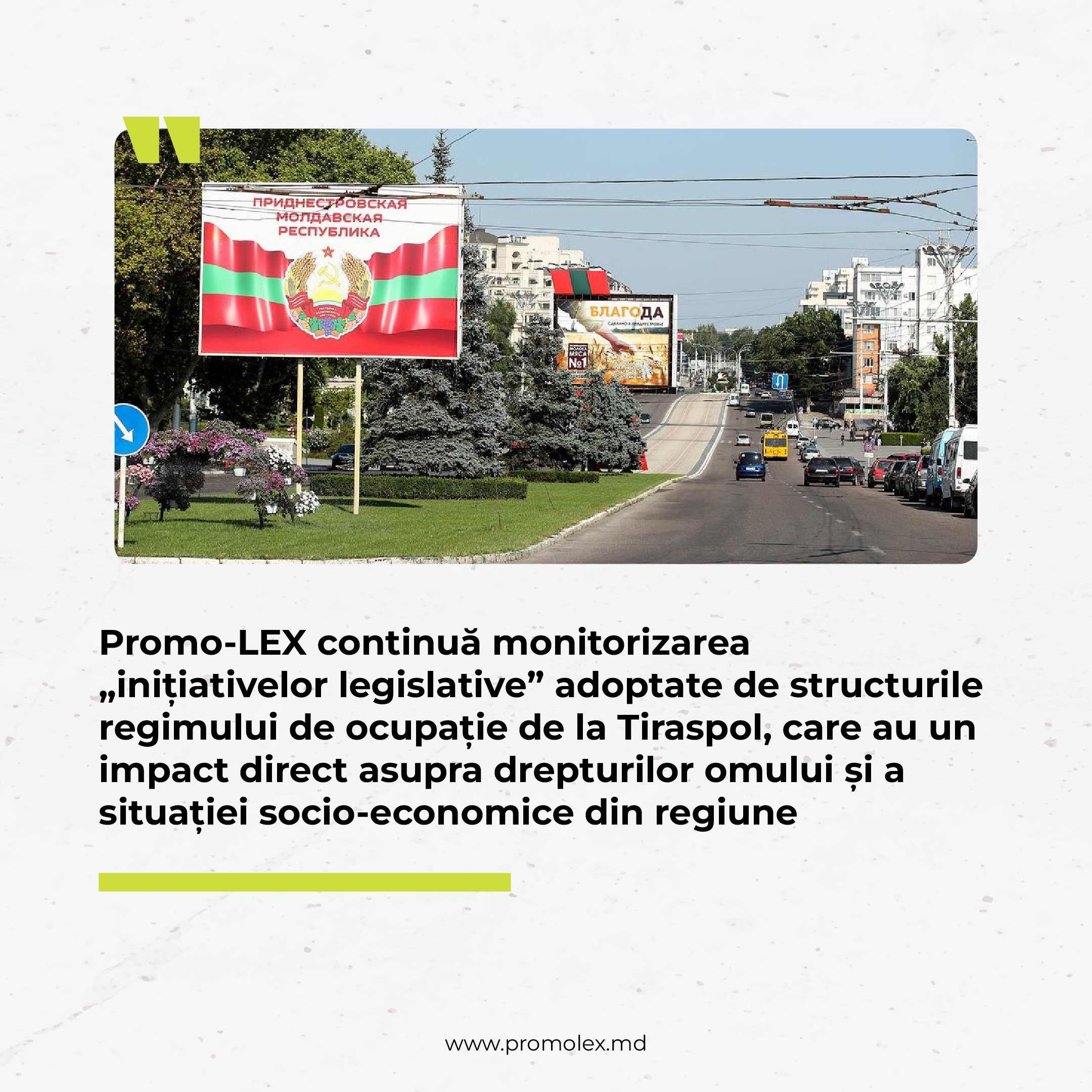
In September 2025, the occupation regime in Tiraspol promoted six “legislative initiatives” that directly affect the human rights situation in the Transnistrian region:
- Schools are required to use the term “Transnistrian people” and to organise visits to propaganda museums. This measure aims to create the false impression of significant identity differences between the populations on the two banks of the Nistru River and to legitimise the occupation regime;
- The so-called “Ministry of Security” in Tiraspol approved regulations on detention conditions in illegal isolation facilities, which blatantly violate international standards. Individuals illegally arrested by “security ministry” staff are held in degrading conditions, in overcrowded spaces without ventilation, natural light, food, medicine, or sanitary facilities;
- A proposal was made to eliminate all provisions that allowed lawyers from outside the region to participate in “criminal procedures”, making access to independent defence impossible, as the so-called local “bar” is politically controlled;
- The revised 2025 budget allocates over 20% of funds to law enforcement, paramilitary structures, propaganda, and “diplomacy”, while healthcare and education remain underfunded;
- A prison sentence of up to 7 years was introduced for the “export” of wood and non-ferrous metals, classified as strategic goods for the region’s economy, while effective defence and protection mechanisms for the region’s residents are lacking;
- The “yellow terrorist alert level”, introduced in 2022 to justify increased security measures, restrictions on free movement, and the narrative of a “fortress besieged by hostile neighbours”, was extended.
These developments show that the occupation regime in Tiraspol is responding to multiple crises through control and repression, with direct consequences for the population, which lacks real defence and protection mechanisms.
This informative material was developed by Promo-LEX Association, with the support of Soros Foundation Moldova, the European Union, and the National Endowment for Democracy. The views expressed in this material do not necessarily reflect the position or opinion of Soros Foundation Moldova, the European Union, or the National Endowment for Democracy.