




10 February, 2026
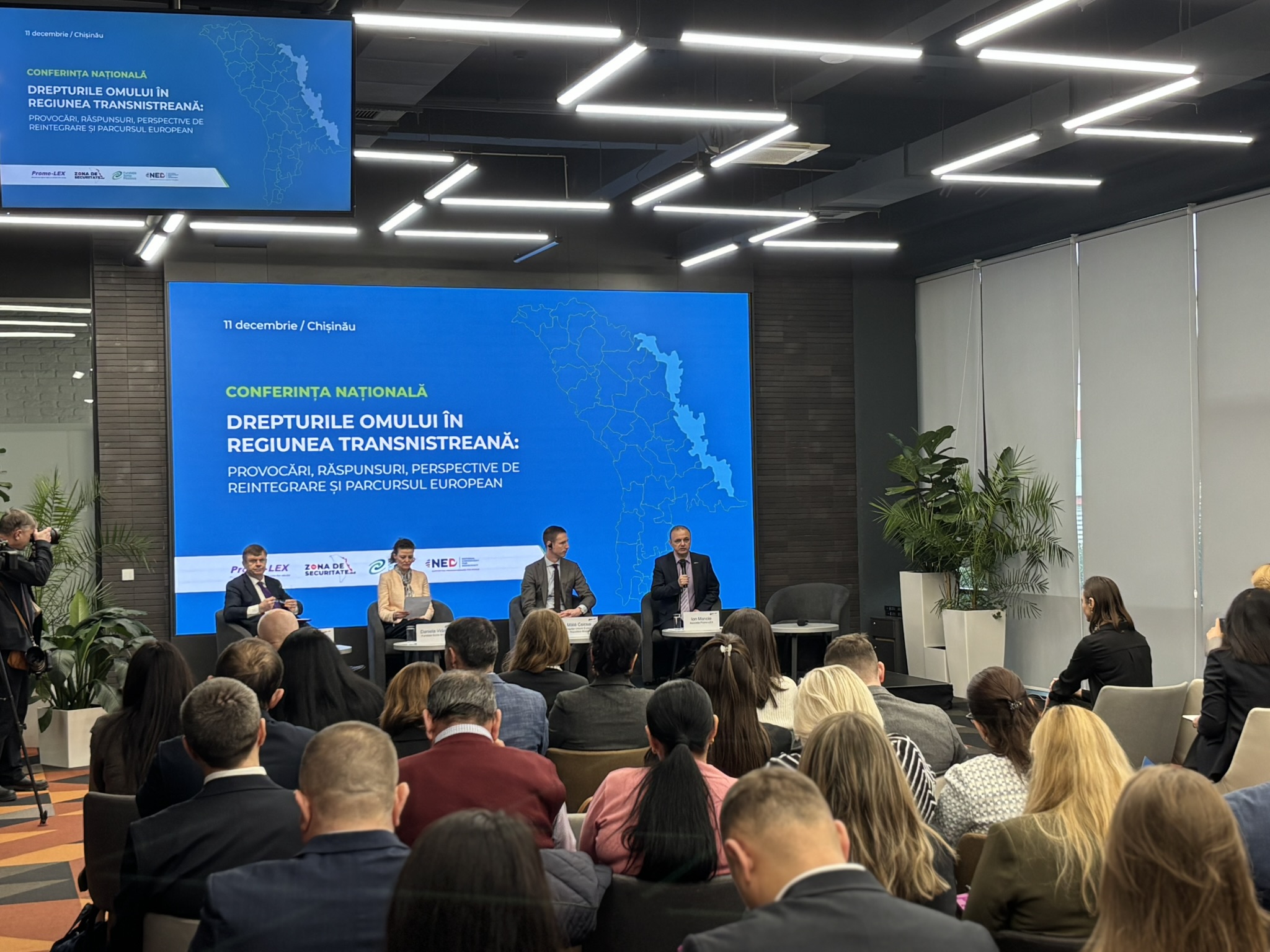
The situation of human rights in the Transnistrian region continues to represent one of the most serious and systemic challenges to the reintegration of the Republic of Moldova and to the advancement of its European integration process. This was the central conclusion of the National Conference “Human rights in the Transnistrian region: challenges, responses, reintegration perspectives and the European path”, organised by the Promo-LEX Association on 11 December 2025.
The event brought together over 100 participants, including representatives of national authorities, international institutions and organisations, diplomats, experts, journalists, civil society representatives and human rights defenders, including from the Transnistrian region, as well as victims of human rights abuses committed by the unconstitutional structures in Tiraspol.
Human rights as a cornerstone of reintegration and European integration
During the opening interventions, speakers stressed that the reintegration of the Republic of Moldova cannot be achieved without genuine respect for human rights and the rule of law. Participants highlighted the direct link between the settlement of the Transnistrian issue and Moldova’s EU accession process, warning that the persistence of a territory marked by systemic violations of fundamental rights risks becoming a major obstacle to European integration.
The positive obligation of the Moldovan state to protect its citizens living on the left bank of the Nistru River was reaffirmed, including through combating impunity, supporting victims of illegal detention, and directly involving residents of the region in shaping an inclusive national vision for reintegration.
Continued deterioration of human rights in 2025
Discussions in the first panel revealed a further deterioration of the human rights situation in the Transnistrian region throughout 2025. Key issues identified included the militarisation and ideologisation of education, total control over the information space, systematic propaganda, inhuman detention conditions, pressure on children and youth, and the absence of effective support mechanisms for victims.
Experts drew attention to the use of education as a tool for indoctrination and russification, including the exposure of children, particularly children with disabilities and institutionalised children, to militarisation and recruitment practices. The role of propaganda and censorship in isolating the population from the informational, cultural and value-based space of the Republic of Moldova was also emphasised.
At the same time, participants pointed to the persistence of impunity and the lack of transparency on the part of constitutional authorities in certain cases, undermining public trust and the state’s capacity to effectively protect its citizens.
Insufficient institutional response and the need for structural reforms
The second panel highlighted the shortcomings of the institutional capacity of the Moldovan authorities to respond effectively to human rights violations in the Transnistrian region. Participants noted the lack of effective inter-institutional coordination, structural deficiencies within the reintegration framework, and the absence of clear assistance mechanisms for persons released from illegal detention.
The need to combat impunity through criminal justice instruments, develop consistent judicial practice, and provide specialised training for judges and prosecutors in the field of transitional justice was strongly emphasised. Expanding access to national public services for residents of the region was also identified as a key confidence-building and social cohesion measure.
Reintegration as an integral part of the European path
The third panel addressed the reintegration of the Transnistrian region in the context of Moldova’s EU integration process. Participants stressed that while reintegration and European integration are distinct processes, they are complementary and require a coherent and strategic approach.
Experts warned against decoupling the Transnistrian dossier from the European integration agenda and underlined the importance of maintaining the state’s principled position of negotiating EU accession for the entire internationally recognised territory. The discussions also highlighted the need to improve strategic communication, develop sectoral reintegration policies, and make more effective use of conditionality mechanisms and targeted sanctions against individuals responsible for serious human rights violations.
Key recommendations of the Conference
Among the main recommendations formulated by participants were:
- strengthening monitoring of the human rights situation in the Transnistrian region and combating impunity;
- establishing clear support and referral mechanisms for victims of illegal detention;
- facilitating access to national public services for residents of the region;
- reactivating and strengthening the institutional architecture responsible for reintegration;
- developing sectoral policies and a clear vision for the reintegration process;
- improving strategic communication on the Transnistrian issue at both national and international levels;
- leveraging the European integration process as a driver for the promotion of human rights and the democratic transformation of the region.
The full Conference Report, bringing together key messages, analyses and expert recommendations, is available here.
The report was prepared by the Promo-LEX Association with financial support from the Soros Foundation Moldova and the National Endowment for Democracy. The Konrad Adenauer Foundation in the Republic of Moldova supported the organisation of the conference by providing international expertise. The views expressed in the report do not necessarily reflect the views or official positions of the Soros Foundation Moldova, the National Endowment for Democracy, or the Konrad Adenauer Foundation in the Republic of Moldova.