




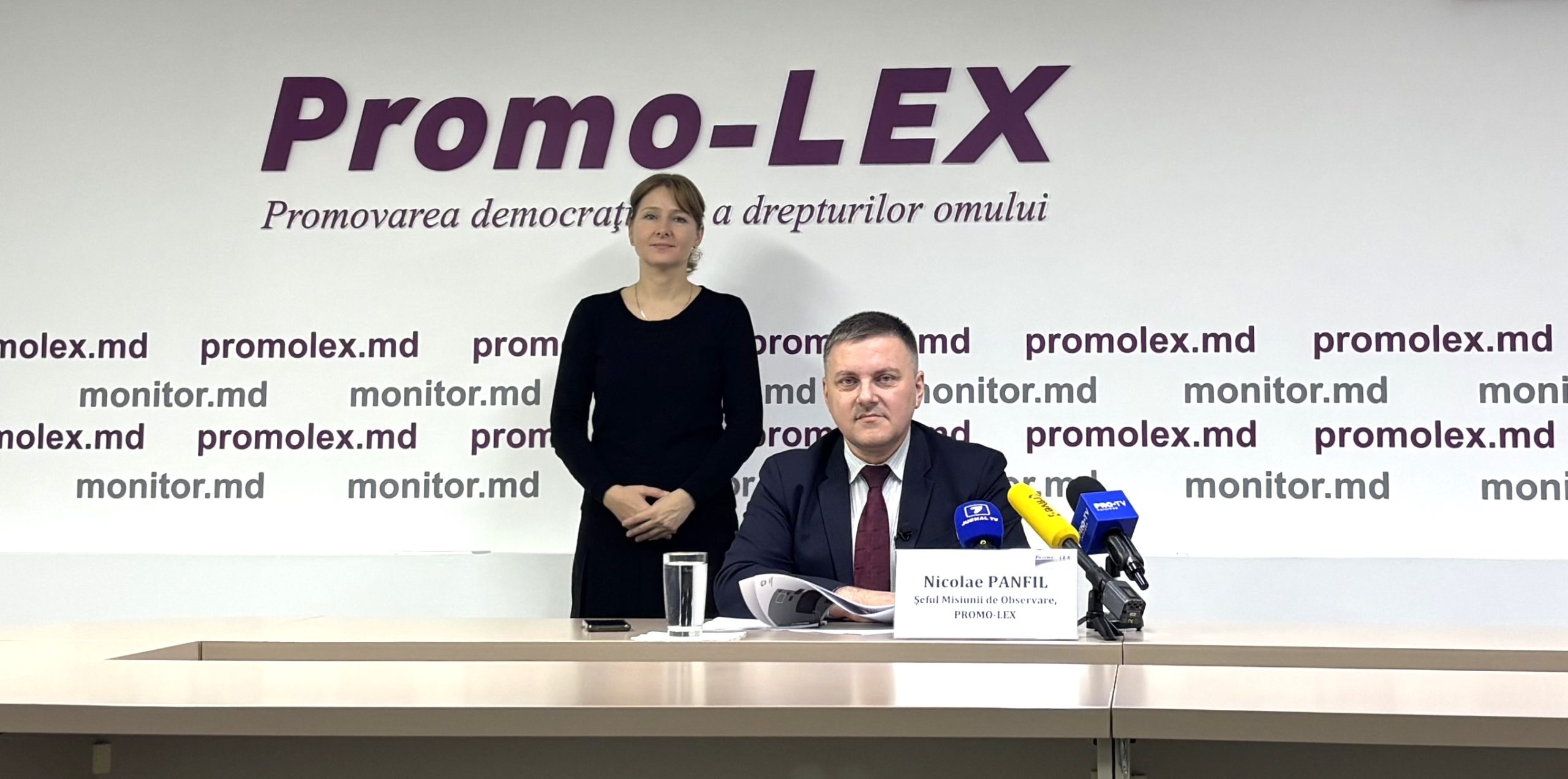
The Promo-LEX Association presented today the fifth report of the Observation Mission (OM) for the presidential elections and the republican constitutional referendum of 20 October, which contains the findings from 21 October – 29 October. The report reflects mainly the electoral campaign for the second round of the presidential elections, which will take place on 3 November, legal framework relevant to this process, performance of the electoral competitors, as well as activity of the electoral bodies aimed at preparing this Sunday’s elections.
Legal framework. In the observation process, the OM found that the electoral body – the Central Electoral Commission (CEC) – does not provide a clear justification for the decisions it issues, especially in cases of rejection of observer accreditation. The CEC rejected the accreditation requests of 775 national observers proposed by „Inimi Grijulii” and „Sufletul și Inima Moldovei” associations, having justified the decision by the involvement of these organizations in political actions and their relations with sanctioned international entities. The CEC emphasized that these organizations could compromise the integrity of the electoral process, and their activity is incompatible with the requirements of neutrality and impartiality required from observers.
When the CEC’s decisions were analyzed, an insufficient justification of the decisions was noted, and additional justifications were identified within a court decision only. The OM recommends the electoral body to provide more detailed justifications for its rejection decisions, thus contributing to a better understanding of reasons and legitimacy of administrative acts issued.
In the observation process, the OM found that some representatives of the electoral competitors were not admitted to the polling stations, because they were not registered by the CEC. This fact suggests that there are difficulties in the interpretation of the legislation and the CEC’s rules by the election officials, which impose the CEC to come up with some additional clarifications. The OM specifies that the provisions of the Electoral Code suggests that the representatives must be confirmed by the electoral body, in which they are going to represent the electoral competitor. This rule seems to burden the activity of electoral competitors, who should submit requests within each PEB, in which they wish to have representatives on election day. The OM believes that the legislator must modify the legal rules, so that the procedure for confirming the representatives of the electoral competitors in the electoral bodies is simple.
Electoral appeals and disputes. During the observed period, seven appeals that refer to the republican constitutional referendum, regarding electoral materials and campaigning, recounting of votes and annulment of the results in diaspora polling stations were submitted to the CEC.
In the same period, the district electoral councils (DECs) received 21 appeals, most of which were submitted in Chisinau and in the diaspora. Most of the appeals concerned the representatives of the electoral competitors, electoral campaigning and irregularities in the electoral lists and were examined within the legal term of at most 3 days. Law enforcement bodies have also stepped up measures against electoral corruption, while the police and NAC carried out investigations and applied seizures. At the same time, the Promo-LEX observed risks regarding the violation of human rights by publishing a list of alleged members of some political formations involved in electoral corruption.
Performance of electoral competitors. During the electoral campaign for the second round of the presidential elections in the Republic of Moldova, at least 268 promotional activities were carried out by the two candidates – Maia Sandu and Alexandr Stoianoglo. Most of the activities focused on distributing electoral materials, and 57% were for Alexandr Stoianoglo – PSRM and 43% for Maia Sandu – PAS. The activities were carried out predominantly in Chisinau, Balti and Donduseni, and the most frequent methods were the distribution of leaflets and meetings with voters.
Electoral advertising was present massively, showing a total number of 872 cases observed, including print, street and online advertising. In the case of Alexandr Stoianoglo, 58% of these materials were observed, and in the case of Maia Sandu, 42% were observed. During the period monitored, at least eight cases of abusive use of administrative resources were found, which targeted Maia Sandu, including cases involving the church in the electoral campaign, as well as of some unions, which is prohibited by law.
In the context of the electoral campaign activities for the second round of the presidential elections, negative campaign activities and disinformation were observed. Propaganda materials and messages intended to discredit both Maia Sandu and Alexandr Stoianoglo were distributed through flyers, videos and posters vandalized. In addition, incidents of verbal and physical aggression between supporters of the candidates were reported.
Election and campaign financing. Electoral competitors submitted financial reports to the CEC within the set deadline, and they were published on the CEC’s website, but in a format that is difficult for users to access. During the period 23–27 October 2024, the two competitors reported total revenues of 2,062,560 MDL, of which 95% were reported by Maia Sandu and 5% of the total amount was declared by Alexandr Stoianoglo. Most of the declared sources come from state allocations and donations from individuals and legal entities.
The declared expenses totaled over 3.3 million MDL, which were directed mostly to the production of advertising videos (57%) and promotional materials (36%). Maia Sandu reported 58% of these expenses and Alexandr Stoianoglo – 48%. During this period, the Promo-LEX identified unreported expenses in the amount of 733,416 MDL, of which 90% related to Alexandr Stoianoglo and 10% to Maia Sandu. Most of them were for promotional materials (87%), volunteer rewards (8%), event management (4%) and online advertising (2%).
Hate speech and incitement to discrimination. Between 7 and 24 October 2024, at least 42 cases of hate speech and other forms of intolerance were identified. 41 cases of them took place in an electoral context. Most of the cases (31 cases) were spread through mobile applications and social networks. The criteria “political affiliation”, “opinion” and “sex/gender” were most often at the basis of hate speeches, during the period monitored. Men (26 cases) aged between 35 and 50 (15 cases) used hate speech most often. During this period, cases of hate speech took the form of promoting stereotypes, sexist language, homophobic speech, promoting and justifying discrimination, as well as inciting to violent actions.
The Observation Mission is financially supported by the United States Agency for International Development (USAID), the European Union and the German Marshall Fund of the USA, the Government of the United Kingdom of Great Britain and Northern Ireland, the International Organization of Francophonie and Soros Foundation Moldova. The Observation Mission is carried out under the aegis of the Civic Coalition for Free and Fair Elections.
For further information, please contact:
Dumitrița Ciuvaga
Communications Manager
Promo-LEX Association
Tel.: +373 68 800 827