




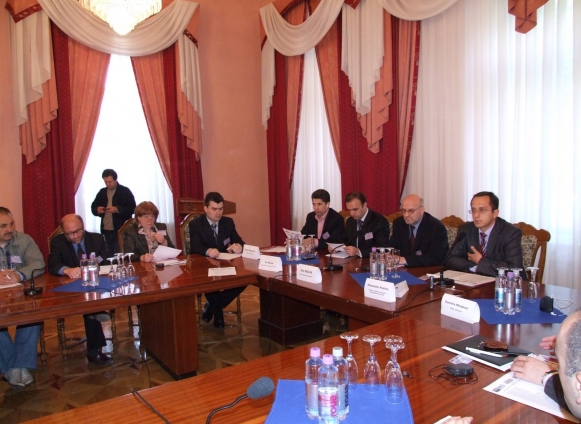
 The Promo-LEX Association organized the conference entitled “The right to liberty and security of person in the regions of conflict” on the 4th and 5th May, the event was hosted in the Hotel Codru in Chisinau. The conference was attended in total by 60 people; representatives of the Ministry of Reintegration, the Ministry of Defense and Justice, representatives from the German, Czech Republic, and Romanian Embassies, the EU Special Representatives to Moldova, Ombudsman, judges and prosecutors from the district courts of Bender, Căuşeni, Dubăsari, Rezina, Floreşti, Grigoriopol, Slobozia and Rîbiniţa. The conference was also attended by representatives of civil society from both sides of the Nistru and that of international organizations concerned with the issue of human rights in the Transnistrian region of Moldova.
The conference not only focused upon the issues of the Transnistrian region of Moldova but also that of zones of “frozen” conflict in Georgia and the North Caucasus region, Russian Federation. On this occasion experts from Georgia and Britain were invited to participate at the conference.
The conference was opened with a word of greeting from Mr Alexandru Postica, the executive director of Promo-LEX, and from Mr Ion Stăvilă, the Vice-Minister of Reintegration. “We will together, with the experts attempt to detect positive examples from these regions to implement into national law, and also the negative of which is to be avoided” Mr Alexandru Postica said.
During the first day of the conference a number of problems relating to the human rights issue in the Transnistrian region were addressed. Mr Dumitru Mânzărari, an expert from the Institute for Development and Social Initiatives “Viitorul”, talked about the regional security issues, mentioning as well the situation of the fragile state of the Republic Moldova. In his speech Mr Mânzărari explained the nature and causes of the conflict and the prospects for solving it.
Within Mr Stăvilă’s presentation, he reported efforts by the Republic of Moldova (herein after R.M.) in resolving conflict and protecting human rights in the Transnistrian region. He stated finally that the ministry’s intention is to contribute to solving any problems that occur on the Transnistrian territory that is within the jurisdiction of this institution.
Popovschii Stepan, a lawyer from the Transnistrian region explained that the courts operating in the Transnistrian region are unable to provide an equitable and fair examination of the cases. He particularly noted the non-transparent and imperfect manner in which the cases are examined in these so called courts. And that it would be necessary to create structures that would be able to consider disputes under the protection of international structures.
The President of the Association of Lawyers for Human Rights, Mr Vladislav Gribincea talked about the issues of jurisdiction in connection with the examination of the complex cases in the region. In light of the case Ilaşcu and others vs Moldova and the Russian Federation, Mr Gribincea concluded that mostly the situation has not changed since the decision was ruled in 2004.
Also on the first day of the conference, Mr Ion Manole made a presentation regarding the freedom and security of persons in Moldova. Within his presentation Mr Manole stated that the addressed issue is itself very complex, as demonstrated when interpreted within the national and European legal systems, as it requires a special approach when examined under a system illegally present in areas devoid of legitimacy and international recognition. Mr Manole also stated that the regime in Tiraspol, being limited in its actions on the territory of the left bank and deprivation of of legitimacy, has no right to deprive people of freedom. In different periods, the constitutional efforts to release political prisoners (Ilascu, Ivanţoc, Petrov-Popa and Leşco) were considerable and appreciated both by national public opinion and the European court. In this context, it is logical to ask whether the Republic should not have to do the same in all cases of arrest or detention brought to their knowledge. However, there were not registered some efforts made in similar cases. Conversely, the vast majority of approaches examining complaints got a single answer – one based on the fact that “due to the political situation created after 1992, law enforcement lack the ability to intervene to defend the rights and legal interests of the Transnistrian region’s inhabitants” or that the Republic of Moldova does not have effective control over this territory, not missing an opportunity to notify the victim or their representatives that ”with the ratification of the ECHR and the Protocols, Moldova declared that will not be able to ensure compliance with the Convention with respect to acts and omissions committed by the self-proclaimed Moldovan Transnistrian Republic on the territory controlled by separatist authorities till the conflict resolution”. But, that it does not possess the de facto constitutional control over the Transnistrian region does not release the (State) Government from the responsibility on the situation of the area.
Mr Manole said that similarly a simple analysis of the past 20 years in the post-soviet and Balkans countries justify the views on the inefficiency of international structures both in terms of prevention of conflicts (former Yugoslavia, Chechnya) and involvement in managing post conflict situations (Georgia, Moldova). Lack of joint efforts and visible results are continuing to affect the lives of millions of people. In my opinion, an increased attention to issues related to human rights could make the situation change.
The second day of the conference was devoted to the situation in the North Caucasus region, Russian Federation and Georgia. Doina Ioana Străisteanu, an expert on human rights reported in this respect on European Court of Human Rights Judgments against Russia regarding Cases from Chechnya. Currently the court has given some 100 decisions on these cases and there are a lot of cases which have not been examined yet. The example of Chechnya was presented as a negative scenario, which is to be avoided in the case of Moldova.
As regards to the freedom and security of person in the conflict in Georgia, Nikoloz Legashvili, Chairman of the Board of the union ”Article 42 of the Constitution” reported on the essence and trends of the conflict in Georgia. Although the case law regarding the causes of human rights violations for Georgia to the European Court is smaller, however the experience related by Nikoloz Legashvili was necessary to understand the importance of negotiations in frozen conflicts.
Also, on the second day of the conference Veaceslav Balan, an expert on human rights, spoke about the International Criminal Court. It was mentioned in this context that, Moldova should firstly ratify the Roma statute, and that secondly this must be done without excluding the Transnistrian region. The importance of this mechanism is shown with regards to illegal actions of individuals against humanity. A clear example of the Rome Statute was the President of Sudan who was recently arrested for crimes against humanity.
Based on the experts’ presentations and participants’ comments it is possible to conclude the following recommendations:
- RM authorities must undertake all the measures that are within the constitutional power to cover information gaps that have persisted in the region for over 17 years;
- To increase the level of confidence of the inhabitants of the left side of Nistru in the Constitutional authorities;
- To equip the legal institutions such as Courts, prosecutors offices and the police departments, specifically created for the districts outside the constitutional authorities jurisdiction and increase the number of the employees of these institutions;
- To take attitudes towards the acts and documents issued by local administration;
- Thorough investigation of each case of violation of the right to liberty and security and it’s proper documentation.
The Conference was organized by Promo-LEX Association in the framework of the project “The right to liberty and security of person in the regions of conflict”, project financially supported by Balkan Trust for Democracy and Black Sea Trust for Regional Cooperation /A Project of the German Marshall Fund.
The basic aim of the project is to identify appropriate and viable solutions for promoting and defending the right to liberty and security of persons from the Left side of the Nistru (Transnistria). Positive practices are taken from regions of conflict and post conflict in Georgia, former Yugoslavia, and Northern Caucasus, through the exchange of experiences at a regional level.
Also in this project a study on the freedom and security of person will be developed in the conflict of Moldova, Georgia, Russian Federation and the former Yugoslavia. The study will be published and presented to the public in September 2009.
DOC – Agenda