




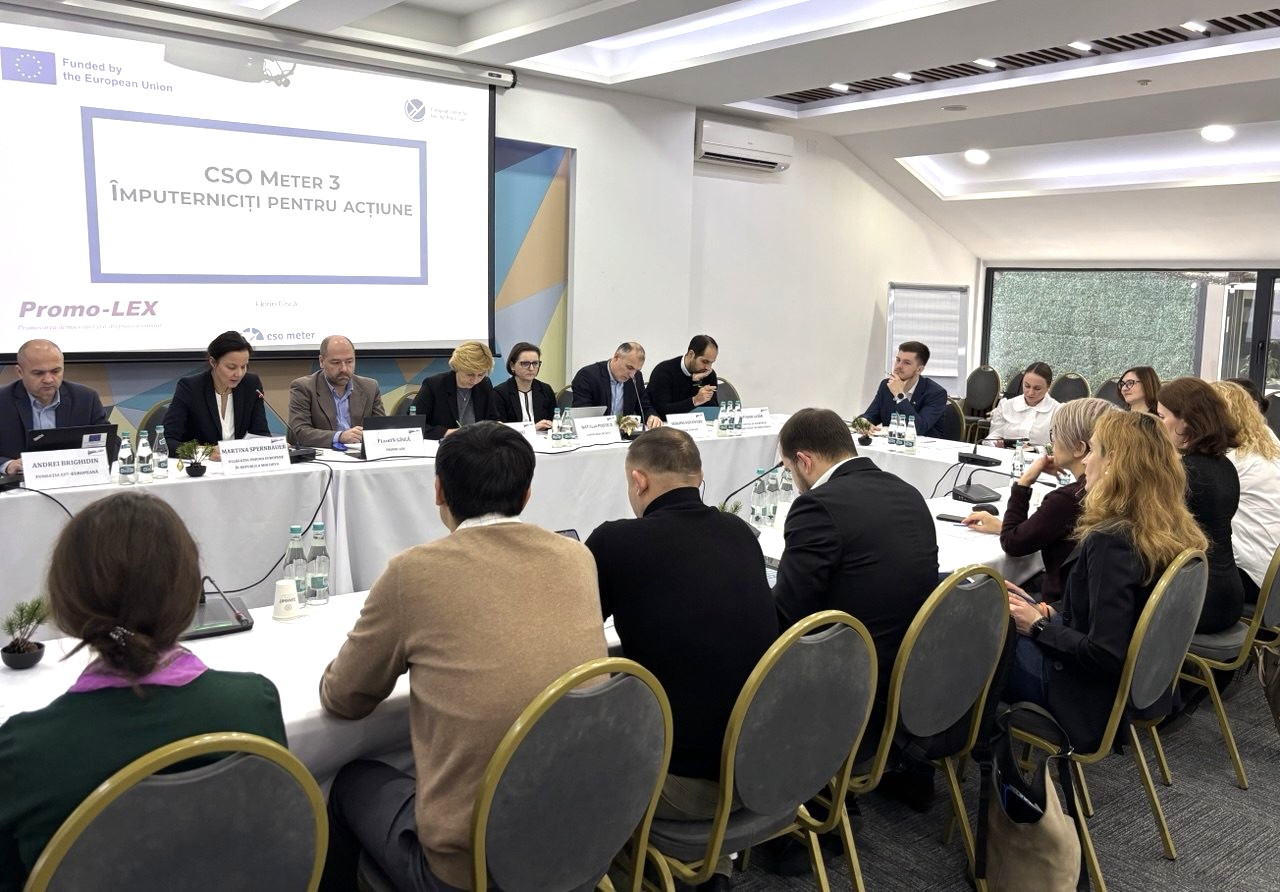
The Promo-LEX Association launches the CSO Meter Moldova 2025 Country Report, a comprehensive assessment of the legislative framework and practices shaping the operating environment for civil society organisations (CSOs) in the Republic of Moldova. The report is presented today, 9 December 2025, during a roundtable event in Chișinău attended by representatives of civil society, public authorities and diplomatic missions.
„We closely monitor the situation and developments within the operating environment of civil society organizations (CSOs) in the Republic of Moldova. In this regard, the CSO Meter Report is a very useful and important tool, as it reflects existing progress and challenges and also provides clear findings and recommendations. We are guided by these recommendations in our efforts to support the advancement of the operating environment for civil society organizations in the Republic of Moldova”, said Martina Spernbauer, Team Leader for Governance at the Delegation of the European Union to the Republic of Moldova, present at the event.
„We are at the seventh edition of the CSO Meter Moldova report. We note that the overall CSO Meter score for the Republic of Moldova remains 4.8, unchanged since 2023. In the meantime, according to the report, in 2025 the CSO environment experienced both progress and setbacks, resulting in score changes in six of the eleven monitored areas. The overall CSO Meter score for the Republic of Moldova remains 4.8, unchanged from 2024. Likewise, the scores for legislation (5.1) and practice (4.4) remain constant. Score increases were recorded in three areas: Right to privacy (4.3 → 4.4) – due to the adoption of amendments that criminalise digital violence; State–CSO cooperation (4.3 → 4.4) – following the Government’s approval of two roadmaps aimed at improving the CSO operating environment; and the Right to participate in decision-making – practice (4.5 → 4.6) – driven by new online platforms and a participatory process in drafting the Law on Public Participation. Score decreases were recorded in: Equal treatment (4.7 → 4.6) – due to discriminatory treatment in the allocation of energy compensation, from which CSOs were excluded and Freedom of peaceful assembly (5.3 → 5.2) – due to restrictions imposed by local authorities, disproportionate sanctions and vague legislative amendments. In the area State duty to protect, scores moved in opposite directions: a decrease in legislation (5.0 → 4.9) and an increase in practice (4.2 → 4.3), maintaining the overall score unchanged”, reported Florin Gîscă, the author of the report, Promo-LEX expert.
The analysis of key developments shows that 2025 was marked by substantial changes. The crisis triggered by the withdrawal of USAID funding created significant pressure on the sector, but was partially mitigated by support from European donors. Meanwhile, the draft law on “foreign agents” fuelled considerable concern but was not endorsed by the pro-European majority. Notably, the Autumn edition of the Public Opinion Barometer recorded a significant increase in public trust in CSOs – from 19% in 2024 to 28% in 2025, signalling the strengthening role of civil society.
The report documents numerous sectoral developments, such as: harmonization of legislation on Local Action Groups with EU standards; initiation of consultations on a new data protection framework; advances on draft laws on public participation, protection of human rights defenders and anti-SLAPP measures; adoption of a new Electronic Communications Law reaffirming the right to internet access and net neutrality; and procedural improvements regarding transparency mechanisms, open data and publishing official information.
The report underscores that maintaining the European integration course after the parliamentary elections is the most important factor of stability for the civil society sector in 2025. In the context of EU accession, a robust, transparent and enabling environment for CSOs is essential for reforms, democratic quality and institutional resilience. In this regard, the authors highlight seven key recommendations, including:
- Increasing tax deductions for philanthropic donations and raising the percentage designation mechanism to 3%;
- Finalising the Law on Public Participation through an inclusive consultation process;
- Establishing a social contracting mechanism within public procurement;
- Ensuring strict compliance with freedom of assembly standards by local authorities and law enforcement;
- Implementing counter-terrorism measures affecting CSOs only in line with FATF Recommendation 8;
- Allocating financial resources to implement the CSO Development Programme 2024–2027;
- Enhancing decision-making transparency at local level and strengthening dialogue platforms.
Promo-LEX also notes that of the 61 recommendations from the CSO Meter Moldova 2024 Report, only three have been fully implemented, while 20 are partially implemented or ongoing.
We remind that the CSO Meter is an annual edition reflecting key developments in the CSO operating environment in Moldova, based on 32 international standards grouped into 11 thematic areas. The report’s methodology is grounded in an extensive consultation process involving forty representatives of civil society organisations and central public authorities.
The report was developed within the project “CSO Meter: Empowered for Action”, implemented with the financial support of the European Union. Its contents are the sole responsibility of the authors and do not necessarily reflect the views of the European Union. The project is implemented by the European Center for Not-for-Profit Law (ECNL) together with its partners: Promo-LEX Association in Moldova; the Anti-Corruption Assistance Centre of Transparency International in Armenia; and ISAR Ednannia in Ukraine.